
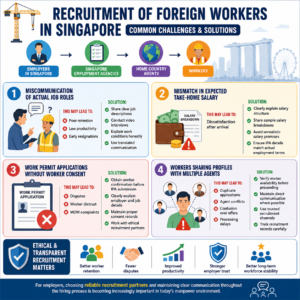
Recruiting foreign workers for Singapore industries such as construction, marine, manufacturing, cleaning, and logistics often involves multiple parties working together across different countries.
While the recruitment process helps companies fill manpower shortages, employers may also face various challenges due to miscommunication, unethical practices, and lack of transparency during hiring.
Understanding who is involved in the recruitment chain — and the common problems that arise — can help employers build a more reliable and compliant hiring process.
Who Are Usually Involved in the Recruitment Process?
1. Employers in Singapore
Singapore employers are the companies hiring foreign workers for their manpower needs.
Their responsibilities usually include:
- Defining job requirements
- Conducting interviews or trade tests
- Applying for Work Permits
- Providing accommodation and employment terms
- Ensuring MOM compliance
Employers rely heavily on recruitment partners to source suitable workers efficiently.
2. Singapore Employment Agencies (EA)
Singapore Employment Agencies act as intermediaries between employers and overseas recruitment channels.
Their role may include:
- Sourcing candidates
- Screening worker profiles
- Coordinating interviews
- Handling documentation
- Assisting with Work Permit applications
- Communicating employer requirements
A professional EA helps reduce recruitment risks and improve hiring quality.
3. Home Country Agents
Home country agents operate in countries such as:
- India
- Bangladesh
- Myanmar
- China
- Thailand
They help identify and prepare workers interested in overseas employment opportunities.
Their responsibilities may include:
- Candidate sourcing
- Trade test arrangements
- Document collection
- Worker briefing
- Medical coordination
However, inconsistent communication between agents can sometimes create confusion for workers and employers.
4. Workers
Workers themselves also play an important role in the recruitment process.
They are expected to:
- Provide accurate information
- Submit genuine documents
- Understand job terms clearly
- Communicate honestly about experience and expectations
When workers receive incomplete or misleading information, disputes may arise after arrival in Singapore.
Common Recruitment Issues Faced by Employers
1. Miscommunication or No Proper Communication of Job Roles
One common issue is workers arriving in Singapore without fully understanding:
- Actual job scope
- Work environment
- Working hours
- Site conditions
- Nature of duties
For example, a worker expecting a general helper role may later discover the job involves heavy construction work or working at height.
This can lead to:
- Early resignations
- Poor productivity
- Worker dissatisfaction
- Attendance problems
Ways to Tackle This Issue
✅ Share clear job descriptions before recruitment
✅ Conduct video interviews when possible
✅ Use translated offer explanations in workers’ native language
✅ Explain working conditions honestly
✅ Avoid unrealistic promises during recruitment
Transparency reduces misunderstandings later.
2. Mismatch in Net Monthly Salary Expectations
Another major issue occurs when workers expect a different “take-home salary” than what is actually received.
This may happen due to misunderstanding regarding:
- Overtime availability
- Levy misconceptions
- Accommodation deductions
- Agent fees
- Basic salary vs gross salary
Workers who expected higher earnings may become unhappy after arrival.
Ways to Tackle This Issue
✅ Clearly explain salary breakdown before deployment
✅ Share sample payslips if possible
✅ Explain overtime is not always guaranteed
✅ Avoid inflated salary promises
✅ Ensure all salary details match IPA and employment terms
Clear financial communication helps build trust.
3. Work Permit Applications Without Worker Consent
Some workers later claim that Work Permit applications were submitted without their knowledge or consent.
This can happen when:
- Profiles are circulated to multiple parties
- Agents submit applications prematurely
- Workers are unaware of employer details
This creates serious issues such as:
- Confusion during arrival
- Disputes between agents
- Worker distrust
- Possible MOM complaints
Ways to Tackle This Issue
✅ Obtain written or video consent from workers before applying
✅ Clearly inform workers about employer name and job details
✅ Verify worker confirmation before IPA submission
✅ Maintain proper recruitment documentation
✅ Work only with ethical recruitment partners
Consent-based recruitment protects both employers and workers.
4. Workers Sharing Profiles with Multiple Agents
In many home countries, workers submit their profiles to several agents simultaneously to increase job opportunities.
This can create problems such as:
- Duplicate applications
- Conflicts between agents
- Confusion over job offers
- Multiple promises made to the same worker
- Delays in processing
Sometimes employers may unknowingly interview the same worker through different channels.
Ways to Tackle This Issue
✅ Verify candidate availability before proceeding
✅ Ask workers to confirm exclusive interest
✅ Maintain direct communication whenever possible
✅ Use trusted recruitment networks
✅ Track worker applications carefully
Strong coordination reduces duplication issues.
Importance of Ethical Recruitment Practices
Ethical recruitment benefits everyone involved:
For Employers
- Better worker retention
- Fewer disputes
- Improved productivity
- Reduced recruitment risks
For Workers
- Better understanding of employment terms
- Reduced financial exploitation
- Safer migration experience
For Agencies
- Improved reputation
- Stronger employer trust
- Long-term business sustainability
Best Practices for Employers
To reduce recruitment challenges, employers should:
✅ Work with reliable and transparent agencies
✅ Communicate job details clearly
✅ Verify worker understanding before deployment
✅ Keep proper documentation and consent records
✅ Avoid unrealistic salary promises
✅ Conduct proper screening and interviews
A transparent recruitment process helps build a stable and productive workforce.
Final Thoughts
Foreign worker recruitment involves cooperation between employers, Singapore employment agencies, home country agents, and workers themselves.
When communication breaks down or unethical practices occur, employers may face unnecessary disputes, delays, and manpower issues.
By focusing on transparency, proper communication, and ethical recruitment practices, companies can improve hiring outcomes while creating a more trustworthy recruitment environment for everyone involved.