
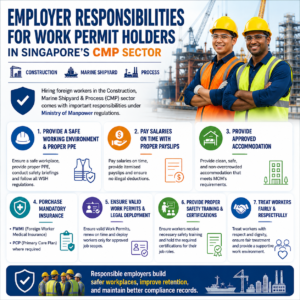
The Construction, Marine Shipyard, and Process (CMP) sectors in Singapore rely heavily on skilled foreign workers. Employers hiring Work Permit holders in these industries must follow strict regulations set by the Ministry of Manpower to ensure worker welfare, workplace safety, and legal compliance.
Understanding these responsibilities helps companies avoid penalties, improve productivity, and maintain a strong workforce.
1. Provide a Safe Working Environment
Safety is critical in the CMP sector due to high-risk work environments.
Employers must:
Provide proper PPE (helmet, safety harness, gloves, safety boots, etc.)
Conduct site safety orientation and toolbox meetings
Ensure workers follow safety procedures
Report serious workplace accidents
Comply with WSH regulations and site safety requirements
A strong safety culture reduces accidents and project delays.
2. Pay Salary on Time
CMP employers must pay workers according to the agreed employment terms.
This includes:
Paying salaries on time
Providing itemized payslips
Recording overtime properly
Avoiding illegal deductions
Keeping proper employment records
Salary disputes are one of the most common worker complaints in Singapore.
3. Provide Proper Accommodation
Employers must ensure workers stay in approved and safe accommodation.
Accommodation should:
Meet Singapore dormitory regulations
Be clean and not overcrowded
Provide proper sanitation and ventilation
Include access to basic necessities
Good living conditions support worker wellbeing and productivity.
4. Provide Mandatory Insurance Coverage
CMP employers are required to provide proper insurance coverage for Work Permit holders.
Important insurance requirements include:
✅ FWMI (Foreign Worker Medical Insurance)
Employers must purchase medical insurance coverage for Work Permit holders to cover:
Hospitalization
Medical treatment
Surgery and healthcare costs
✅ PCP (Primary Care Plan)
For workers staying in dormitories, employers may need to provide a Primary Care Plan (PCP), which includes:
Primary healthcare services
Telemedicine support
Preventive care
Medical consultations
Employers must also pay for:
Mandatory medical examinations
Work injury medical treatment when required
5. Do Not Keep Workers’ Passports Improperly
A worker’s passport belongs to the worker.
Employers should only hold passports temporarily for official purposes such as:
Work Permit processing
Medical appointments
Immigration matters
The passport should be returned immediately after use.
6. Follow Work Permit and Deployment Rules
CMP employers must:
Hire workers only for approved job scopes
Ensure Work Permits remain valid
Renew permits on time
Avoid illegal deployment to other companies or unrelated job roles
Non-compliance can lead to:
MOM penalties
Work pass suspension
Debarment from hiring foreign workers
7. Ensure Proper Training and Certification
CMP employers should ensure workers have the required certifications where applicable, such as:
Safety courses
SEC(K)
CoreTrade
Multi-Skilling certifications
Trade-specific qualifications
Properly trained workers improve work quality and site safety.
8. Treat Workers Fairly and Respectfully
Employers should maintain a professional and respectful work environment.
This includes:
Fair treatment
No harassment or abuse
Proper rest days
Clear communication
Timely issue resolution
Workers who are treated well are more likely to stay longer and perform better.
9. Arrange Repatriation When Employment Ends
When employment ends, employers are responsible for arranging the worker’s return home unless the worker legally transfers to another employer.
Why Employer Compliance Matters in the CMP Sector
Responsible CMP employers benefit from:
Better worker retention
Improved site productivity
Fewer safety incidents
Stronger MOM compliance records
Better company reputation
Final Thoughts
In Singapore’s CMP sector, hiring foreign workers comes with serious responsibilities. Employers who prioritise worker welfare, safety, and legal compliance can build a stronger and more sustainable workforce.
Following MOM regulations is not just a legal requirement — it is essential for long-term business success in the Construction, Marine Shipyard, and Process industries.