
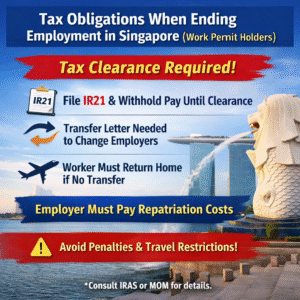
Ending employment in Singapore involves important tax and legal responsibilities, especially for Work Permit holders. Both employers and workers must clearly understand these obligations to avoid penalties, delays, or disputes.
This guide explains the tax clearance process, change-of-employer rules, and repatriation responsibilities in simple terms.
1. Tax Clearance Requirement (IRAS)
When a foreign employee (including Work Permit holders) stops working, leaves Singapore, or changes employer, tax clearance is mandatory.
What is Tax Clearance?
Tax clearance is the process of ensuring all income taxes owed by the employee are fully paid before they leave Singapore or end employment.
Employer’s Responsibility – Form IR21
- Employers must submit Form IR21 (Tax Clearance Form) to IRAS.
- The form must be filed at least 30 days before the employee’s:
- Last working day, or
- Departure from Singapore, whichever is earlier.
- Employers must withhold all salary, bonuses, and payments from the date they are aware of employment cessation until IRAS confirms tax clearance.
Employee’s Responsibility
- Ensure all income details are correctly declared.
- Cooperate with the employer during the tax clearance process.
- Pay any outstanding tax assessed by IRAS promptly.
⚠️ Failure to complete tax clearance can lead to fines, travel restrictions, or future work pass issues.
2. Can a Work Permit Holder Change Employers?
Work Permit holders cannot freely change employers.
Transfer Letter Requirement
- A Work Permit holder can change companies only if the current employer issues a Letter of Transfer (Consent Letter).
- Without this letter, the worker must return to their home country once employment ends.
This rule is strictly enforced by the Ministry of Manpower (MOM).
3. Repatriation Obligations – Employer’s Responsibility
If employment ends and no transfer is granted:
Employer Must Bear Repatriation Costs
The employer is legally responsible for:
- Airfare to the worker’s home country
- Reasonable travel-related expenses
This applies even if:
- The contract ends
- The employer terminates the worker
- The worker resigns
Employers cannot pass repatriation costs to the worker.
4. Common Mistakes to Avoid
❌ Delaying IR21 submission
❌ Releasing salary before tax clearance approval
❌ Forcing workers to pay their own repatriation costs
❌ Misleading workers about transfer eligibility
These mistakes can result in penalties from IRAS and MOM.
5. Key Takeaways
✅ Tax clearance is compulsory for all foreign workers ending employment
✅ Employers must file IR21 and withhold payments until clearance
✅ Work Permit holders need a transfer letter to change employers
✅ Without transfer approval, workers must return home
✅ Employers must pay repatriation costs
Disclaimer: This article is for general information only and does not constitute legal or tax advice. Always consult IRAS or MOM for case-specific guidance.