
Hiring the right workers is one of the biggest challenges for construction companies in Singapore. Employers often face an important decision:
✅ Should you hire transfer workers already in Singapore?
OR
✅ Should you bring in new workers from overseas?
Both options have advantages and challenges. Choosing the right manpower strategy can help companies reduce costs, improve productivity, and avoid project delays.
What Are Transfer Workers?
Transfer workers are existing Work Permit holders already working in Singapore who are eligible to transfer to a new employer.
These workers may already have:
- Singapore construction site experience
- Safety certifications
- Knowledge of local work culture
- Basic English communication skills
- Familiarity with MOM regulations
Many employers prefer to transfer workers because they can start work faster compared to newly arrived workers.
What Are New Workers?
New workers are recruited directly from overseas countries such as:
- India
- Bangladesh
- Myanmar
- China
- Thailand
These workers usually enter Singapore after going through medical checks, training, documentation, and Work Permit approval processes.
Advantages of Hiring Transfer Workers
1. Faster Deployment
Transfer workers are already in Singapore, which means employers can reduce waiting time for:
- IPA processing
- Overseas travel arrangements
- Entry approvals
- Quarantine or onboarding delays
This helps companies handle urgent manpower shortages quickly.
2. Lower Initial Costs
Hiring transfer workers may reduce certain expenses such as:
- Overseas recruitment costs
- Air tickets
- Overseas agent fees
- Pre-arrival accommodation arrangements
This can help companies better manage manpower budgets.
3. Experience in Singapore Worksites
Most transfer workers already understand:
- Site safety requirements
- Local construction practices
- Working environment in Singapore
- Productivity expectations
This often results in faster adaptation and less supervision.
4. Immediate Productivity
Experienced transfer workers can usually begin work with minimal training.
For construction projects with tight deadlines, this can improve operational efficiency.
Challenges of Hiring Transfer Workers
1. Limited Availability
Good transfer workers are in high demand. Companies may face competition when trying to hire experienced workers.
2. Salary Expectations
Experienced transfer workers may request:
- Higher salaries
- Better accommodation
- Improved benefits
Employers need to balance cost and experience carefully.
3. Skill Matching Issues
Not every transfer worker may match the exact trade requirements needed for the project.
For example:
- Scaffolding
- Formwork
- Rebar work
- Welding
- Electrical work
Careful screening is important.
Advantages of Hiring New Workers
1. Wider Talent Pool
Recruiting overseas gives employers access to a larger number of workers across different trades and skill levels.
This is useful for large-scale projects requiring bulk manpower.
2. Long-Term Workforce Planning
New workers can be trained according to company standards from the beginning.
This may help companies build a more stable long-term workforce.
3. Lower Salary Expectations Initially
Some newly arrived workers may accept lower starting salaries compared to experienced transfer workers.
However, employers must still ensure compliance with MOM salary regulations and ethical hiring practices.
Challenges of Hiring New Workers
1. Longer Processing Time
Bringing in new workers may involve:
- Recruitment coordination
- Overseas testing
- Documentation
- Medical examinations
- Work Permit processing
This can delay manpower deployment.
2. Training & Adjustment Period
New workers may need time to adapt to:
- Singapore safety standards
- Work culture
- Construction methods
- Language communication
Additional supervision may be required initially.
- Higher Initial Recruitment Costs
Employers may incur costs related to:
- Overseas agencies
- Travel arrangements
- Settling-in programs
- Training and onboarding
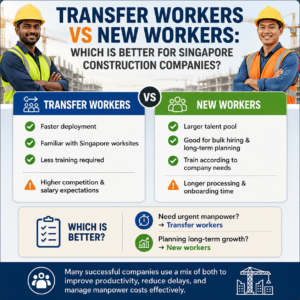
Which Option Is Better for Construction Companies?
The best option depends on your company’s needs.
Transfer Workers May Be Better If:
✅ You need manpower urgently
✅ You want workers with Singapore experience
✅ You want faster deployment
✅ Your projects have tight deadlines
New Workers May Be Better If:
✅ You need large numbers of workers
✅ You are planning long-term manpower growth
✅ You want to train workers internally
✅ You need specific trade skills from overseas recruitment
Best Strategy: A Balanced Workforce
Many successful construction companies use a combination of:
- Experienced transfer workers
- Carefully selected new workers
This helps balance:
- Cost
- Productivity
- Stability
- Workforce continuity
A mixed manpower strategy can reduce operational risks while supporting project growth.
Final Thoughts
Both transfer workers and new workers play important roles in Singapore’s construction industry.
There is no one-size-fits-all solution. Employers should evaluate:
- Project timeline
- Budget
- Skill requirements
- Workforce planning goals
before deciding on the best hiring approach.
Choosing the right manpower strategy can improve productivity, reduce delays, and support long-term business success in the construction sector.