
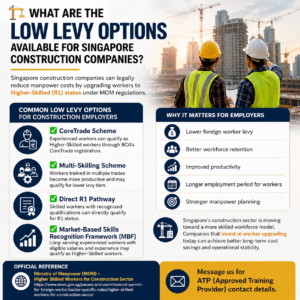
Singapore’s construction industry continues to face manpower challenges and rising operational costs. To encourage productivity and skills upgrading, the Singapore government provides lower foreign worker levy options for construction companies that employ Higher-Skilled (R1) workers.
By upgrading workers through approved schemes, employers can reduce levy costs legally while building a more stable and productive workforce.
Understanding Higher-Skilled (R1) Workers
Under Singapore’s Ministry of Manpower (MOM) regulations, construction workers who meet certain skill and experience requirements can qualify as Higher-Skilled (R1) workers.
Compared to Basic-Skilled (R2) workers, R1 workers generally enjoy:
- Lower foreign worker levy rates
- Longer maximum employment periods
- Better career progression opportunities
For employers, this means lower long-term manpower costs and improved workforce retention.
Common Low Levy Options for Construction Employers
1. Core Trade Scheme
The Core Trade Scheme by the Building and Construction Authority (BCA) helps experienced construction workers become Higher-Skilled workers.
Workers registered under Core Trade are recognized for their:
- Technical skills
- Work experience
- Supervisory capabilities
This pathway supports the development of a more competent and stable construction workforce in Singapore.
2. Multi-Skilling Scheme
The Multi-Skilling Scheme allows workers to be trained in multiple construction trades.
Examples include:
- Formwork and plastering
- Tiling and painting
- Electrical and general construction works
Multi-skilled workers improve operational flexibility and productivity, while helping companies qualify for lower levy tiers.
3. Direct R1 Pathway
Some skilled workers can directly qualify for Higher-Skilled (R1) status if they possess:
- Recognized qualifications
- Relevant certifications
- Approved construction skills training
This pathway is useful for employers hiring experienced foreign construction workers with existing trade skills.
4. Market-Based Skills Recognition Framework (MBF)
The Market-Based Skills Recognition Framework (MBF) allows long-serving and experienced workers to qualify as Higher-Skilled workers based on:
- Years of working experience
- Salary criteria
- Employer sponsorship
This framework helps employers retain experienced workers while benefiting from reduced levy costs.
Benefits of Lower Levy Schemes for Employers
Construction companies that upgrade workers through approved pathways can enjoy several advantages:
✔️ Lower foreign worker levy costs
✔️ Better workforce retention
✔️ Improved productivity
✔️ Longer employment duration for workers
✔️ Stronger manpower planning
✔️ Reduced dependency on frequent worker replacement
Why Skills Upgrading Matters
Singapore’s construction sector is steadily moving toward a highly skilled workforce model. Employers who invest in training and upgrading workers today can achieve:
- Better project efficiency
- Higher work quality
- Long-term operational stability
- Greater cost savings
Companies that proactively upgrade workers are also better prepared for future industry regulations and manpower requirements.
Official MOM Reference
For detailed eligibility requirements and levy information, refer to the official MOM guidelines:
Need Help With Worker Upgrading?
📩 Message us for ATP (Approved Training Provider) contact details and guidance on upgrading construction workers to Higher-Skilled (R1) status.